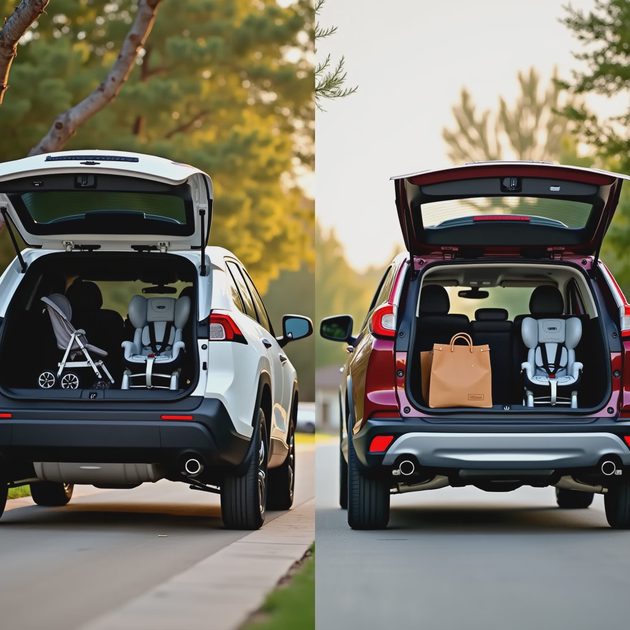
Let’s keep this practical.
So you’ve narrowed the family SUV search to the two obvious heavyweights: Toyota RAV4 and Honda CR-V. Smart start. Both are best-sellers for good reason. But “both are good” isn’t a decision—it’s a starting point. The question is which one makes more sense for your family in 2026, with the trims and prices that exist right now, not the ones from five years ago.
I’ve dug through the latest specs, real-world owner discussions, and ownership cost data. Here’s how these two actually compare when you’re loading child seats, calculating long-term fuel spend, and planning to keep the vehicle past the warranty window.
The Powertrain Fork in the Road: All-Hybrid vs. Still-Choosing
The biggest change for 2026 is that Toyota went all-in: every RAV4 is now a hybrid. The base powertrain puts out 226 horsepower (FWD) or 236 hp (AWD), and there’s a plug-in hybrid option with 324 hp and up to 52 miles of electric-only range. Honda still offers the CR-V with a 190-hp turbocharged gasoline engine on lower trims, or a 204-hp hybrid on higher ones.
What this means for you
If you want a hybrid, Toyota forces the decision—you're getting one. Honda makes you choose, and the entry-level CR-V LX at $30,920 is gasoline-only. The CR-V Hybrid starts at $35,630, while the base RAV4 Hybrid begins at $29,800. That's nearly a $6,000 gap at the entry point.
On paper, the RAV4’s hybrid system looks better on fuel economy: EPA-estimated 48 mpg city / 42 highway with FWD, versus the CR-V Hybrid’s 43/36 mpg. Over five years of family driving—say, 12,000 miles annually—that 5-mpg difference in combined driving can save you roughly $400-500 in fuel costs, depending on gas prices. Not life-changing, but not nothing.
The spec sheet is only half the story, though. Despite lower horsepower numbers, the CR-V Hybrid actually feels quicker off the line thanks to more torque (247 lb-ft vs. the RAV4’s 163 lb-ft from the gas engine alone). In family terms: merging onto highways and pulling away from stoplights feels more confident in the Honda, even if the Toyota wins on paper horsepower.
The Space Question: Where Inches Actually Matter
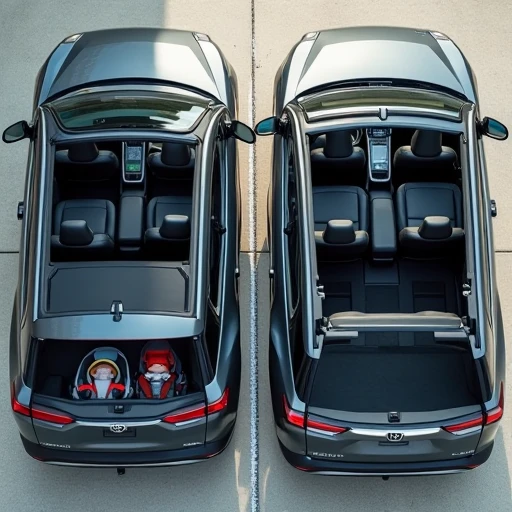
Here’s where I need to be honest about something. On paper, these two look close in cargo volume. In daily family use, there’s a clear difference—and it’s not what the spec sheets suggest at first glance.
The CR-V offers more rear legroom: 41 inches versus the RAV4’s 37.8 inches. That 3.2-inch difference is the gap between “my knees are fine” and “stop kicking the back of my seat.” If you’re running rear-facing child seats, that extra space translates directly into whether the front passenger can sit comfortably without eating the dashboard.
Cargo-wise, it’s a split decision. The RAV4 actually provides slightly more space behind the second row—37.8 cubic feet versus 36.3 in the CR-V Hybrid. That’s the “groceries and a stroller” zone. But fold the seats down, and the CR-V pulls ahead with up to 76.5 cubic feet of maximum cargo volume versus the RAV4’s 70.4. For weekend trips to the hardware store or packing for a family vacation, the Honda gives you more room to work with.
One detail that deserves attention
Multiple reviewers note the RAV4’s rear doors don’t swing open as wide as the CR-V’s. If you’ve ever wrestled a toddler into a rear-facing car seat in a tight parking space, you know exactly why this matters. The CR-V makes that daily ritual measurably easier.
5-Year Ownership Logic: Resale, Reliability, and the Battery Question
If you plan to keep this SUV past the warranty window, pay attention here. This is where the two paths diverge most sharply.
Resale value
The RAV4 holds its value better. Period. J.D. Power data predicts the RAV4 will retain approximately 53.9% of its original price after five years. Toyota’s reputation for hybrid longevity—plus the 2026 shift to an all-hybrid lineup—has only intensified demand. Honda CR-V resale is solid but doesn’t match Toyota’s trajectory.
Reliability ratings
Here’s a twist: J.D. Power gives the 2026 CR-V Hybrid a predicted reliability score of 83 out of 100 (“Great”), while the RAV4 scores a 77 (“Average”). Toyota’s hybrid battery warranty is better—10 years/150,000 miles versus Honda’s 8-year/100,000-mile hybrid component coverage. But the CR-V’s simpler hybrid architecture may have real-world longevity advantages, according to some long-term analyses.
Interior and comfort over time
The CR-V’s cabin is quieter, more refined, and subjectively more comfortable on long drives. The RAV4’s interior has improved for 2026, but still prioritizes durability over luxury—and engine noise at highway speeds remains a noted drawback. You spend thousands of hours inside this vehicle. Don’t ignore how it feels to sit in it.
Maintenance reality check
Toyota’s hybrid system has decades of proven track record behind it. Lower-stress Atkinson-cycle engines, fewer wearing components in the transmission. Honda’s system is excellent but doesn’t have quite the same multi-decade track record. For buyers planning to drive past 100,000 miles, that matters.
Which One Makes More Sense in 2026?
Here’s the honest breakdown based on real family priorities:
Choose the Toyota RAV4 if:
You prioritize the lowest possible long-term fuel costs
You plan to sell or trade within five years and want maximum resale value
You want the reassurance of Toyota’s 10-year battery warranty
You prefer the confidence of an all-hybrid lineup with proven reliability
Choose the Honda CR-V if:
Rear-seat passenger space and child-seat accessibility are daily priorities
You value cabin quietness and ride comfort over absolute fuel economy
Maximum cargo flexibility (folded seats down) matters for your weekends
You want strong hybrid efficiency without sacrificing daily drivability
My take for the typical four-person family in 2026: The CR-V Hybrid wins on the daily experience—loading kids, sitting in traffic, feeling the cabin quality, accessing the cargo area. The RAV4 wins on the long-term spreadsheet—fuel savings, resale value, and powertrain confidence. Which one tips the scale depends on how long you’re keeping it and what frustrates you more: a noisy highway cruise or a slightly higher five-year cost of ownership.
Both are solid. Neither is perfect. That’s why test drives with your actual child seats matter more than any comparison article.



No letters yet — pray write the first.