Let's keep this practical.
The transmission is the second most expensive component in your family SUV after the engine. When it fails, the repair bill can total 3,500 to 5,500—the kind of number that makes you consider whether the vehicle is even worth fixing. So the choice between a continuously variable transmission and a conventional automatic isn't academic. It's a long-term cost question dressed in engineering terminology.
CVTs have taken over the compact SUV segment. Subaru, Honda, Nissan, and Toyota all use them. Automakers like them because they're lighter, mechanically simpler in some respects, and can keep the engine in its most efficient operating range. Conventional automatics with fixed gear ratios are increasingly found in larger SUVs, performance-oriented models, and vehicles from manufacturers that have decided the CVT's tradeoffs aren't worth it.
Here's what the two transmission types actually mean for the family buyer planning to keep a vehicle past the warranty window—what drives differently, what costs more to maintain, and which one holds up better when the odometer crosses six figures.
How They Actually Work
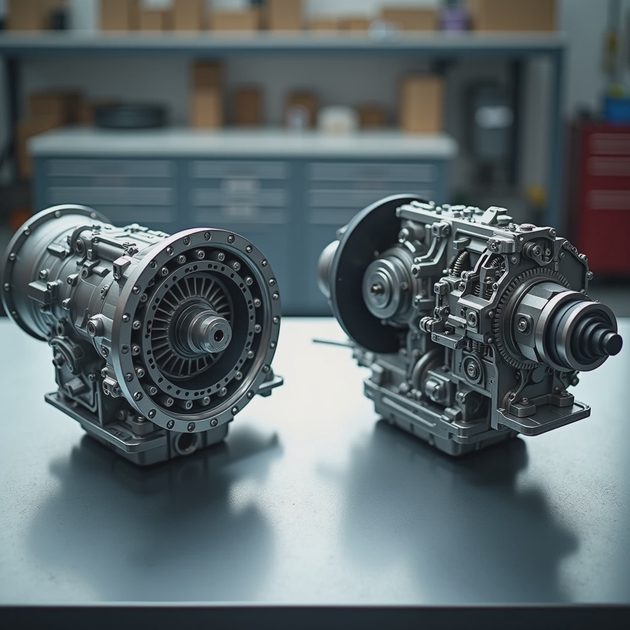
A conventional automatic transmission uses a set of planetary gears and clutch packs to create distinct, fixed gear ratios—typically six to ten speeds depending on the vehicle. A torque converter handles the connection between the engine and transmission, allowing smooth starts and gear changes. This design has been refined over decades. Independent mechanics understand it thoroughly. The failure modes are known, and the repair procedures are standardized.
A CVT replaces fixed gears with a belt or chain running between two pulleys that can vary their effective diameters continuously. Instead of stepping between gear ratios, the transmission constantly adjusts to keep the engine at its most efficient rpm for the current driving conditions. Under hard acceleration, the engine may hold a steady, high rpm while the vehicle accelerates—a sensation that some drivers find unsettling and others simply get used to.
The engineering tradeoff is straightforward. The conventional automatic has more individual parts but operates under lower continuous stress on any single component. The CVT has fewer major components but subjects its belt or chain to constant friction and pressure. Which approach holds up better depends on driving conditions, maintenance discipline, and the specific design choices made by each manufacturer.
The spec sheet is only half the story. The other half is whether the transmission still shifts smoothly at 100,000 miles, and what it costs if it doesn't.
Where CVTs Have Earned Their Bad Reputation
CVT reliability varies enormously by manufacturer. Treating all CVTs as the same is like treating all turbocharged engines as the same—it misses the point entirely.
Nissan's early CVTs, particularly those paired with V6 engines in Pathfinders and Muranos from the early 2010s, are the primary source of the CVT's poor reputation. These transmissions experienced high failure rates, often before 80,000 miles. Nissan extended warranties on affected models and has since improved the design, but the damage to the CVT's reputation was done. If you're shopping for a used Nissan with a CVT, a pre-purchase inspection by a transmission specialist is non-negotiable.
Subaru's CVTs have also faced scrutiny. The early versions in 2010-2014 Outbacks and Foresters had torque converter and valve body issues that led to extended warranty coverage. Subaru has refined the design with each generation, and 2017-and-newer models have measurably lower failure rates. The Forester, Outback, and Ascent all use versions of Subaru's Lineartronic CVT, and the current generation is competitive with conventional automatics for reliability—provided the fluid is changed on schedule.
Honda's CVTs have been the strongest performers in the segment. Used across the Civic, CR-V, and Accord, Honda's CVT design uses a steel belt and has posted low failure rates in long-term ownership data. Honda's engineering approach to CVTs has been conservative, and the results reflect that. The CR-V's CVT is not a liability—it's one of the more reliable transmissions in the compact SUV segment.
Toyota's approach is slightly different. The CVT used in the Corolla and Corolla Cross includes a physical first gear—a "launch gear"—that handles the high-stress initial acceleration before handing off to the CVT belt. This design reduces wear on the belt and pulleys during the highest-load phase of operation. It's a smart engineering solution that addresses the CVT's primary wear point.
If you plan to keep this SUV past the warranty window, pay attention to which manufacturer built the CVT. The difference between a 2014 Nissan CVT and a 2020 Honda CVT is the difference between a transmission that's likely to fail and one that's likely to outlast the rest of the vehicle.
Where Conventional Automatics Still Win
Conventional automatic transmissions have been refined over so many decades that even mediocre designs are reasonably durable, and the best designs are nearly bulletproof.
The ZF 8-speed automatic used in various Stellantis and BMW products has a reputation for smooth shifting and high durability. The Aisin 8-speed found in Toyota trucks and SUVs is widely considered one of the most reliable transmissions on the market. General Motors' 10-speed automatic, co-developed with Ford and used in the Chevrolet Traverse and Tahoe, has proven itself in heavy-duty applications and carries that durability into family SUV use. Mazda's in-house 6-speed automatic is conservative, proven, and has posted excellent reliability scores across the CX-5 and CX-50 lineups.
The conventional automatic's primary advantage is its maturity. The design has been iterated across millions of vehicles. Independent transmission shops can rebuild a 6-speed or 8-speed automatic with standard tools and widely available parts. The same can't always be said for CVTs, which often require specialized diagnostic equipment and manufacturer-specific replacement parts.
The tradeoff is fuel economy and packaging. CVTs are lighter and can keep the engine in its most efficient operating range more consistently than a conventional automatic with fixed gear ratios. A CR-V with a CVT will typically return 1 to 3 mpg better than a comparable SUV with a conventional automatic. Over five years of family driving, that's a real difference—but it's also a difference that a single transmission repair can erase entirely.
The Maintenance Gap Nobody Discusses

CVTs are more sensitive to fluid condition than conventional automatics. The belt and pulley system relies on precisely calibrated friction characteristics in the transmission fluid. As the fluid ages and accumulates wear particles, the friction characteristics change, and the transmission's behavior degrades. Delayed fluid changes are the single most common contributor to CVT failures.
Most manufacturers recommend CVT fluid changes at 30,000 to 60,000 miles under normal service, and more frequently under severe service—which includes most family driving with stop-and-go traffic, cold starts, and occasional cargo loading. A CVT fluid change typically costs 200 to 400 at a dealership or independent shop that stocks the correct fluid. That's a meaningful line item compared to conventional automatic fluid changes, which can often go 60,000 to 100,000 miles between services and cost less when performed.
Conventional automatics are more tolerant of extended fluid change intervals. While no transmission should be neglected, a conventional automatic that misses a fluid change by 10,000 miles is unlikely to suffer immediate consequences. A CVT that regularly sees extended intervals between fluid changes is at measurably higher risk of belt or bearing failure.
The practical takeaway: if you're the kind of owner who follows the maintenance schedule to the mile, a modern CVT from Honda, Toyota, or Subaru will serve you well. If you're the kind of owner who occasionally forgets a service interval because life gets busy, a conventional automatic provides a wider margin of error.
Which One I'd Recommend
For the family buyer who leases and trades every three years, the CVT versus conventional automatic decision barely matters. Both transmission types will perform flawlessly through the lease term with nothing more than routine fluid changes at the dealer during scheduled maintenance visits. Buy whichever vehicle meets your space, safety, and budget requirements.
For the family buyer who plans to keep the vehicle for eight years or more, I lean toward conventional automatics and the most proven CVT designs. The conventional automatic in a Mazda CX-5 or Toyota Highlander is a known quantity with predictable long-term costs. The Honda CVT has earned its place on the reliable side of the ledger. The Subaru CVT in 2017-and-newer models is solid, provided the fluid is changed on schedule.
What I'd avoid: any Nissan CVT from before 2020, any Subaru CVT from before 2015, and any CVT from a manufacturer that doesn't have a documented track record of standing behind the design with extended warranty coverage.
One final thought: the hybrid systems from Toyota, Honda, and Hyundai use a planetary gearset power-split device that functions as a continuously variable transmission but shares almost nothing mechanically with a belt-driven CVT. These hybrid transmissions have proven exceptionally reliable over decades of use. If transmission longevity is your primary concern and a hybrid fits your budget, the hybrid path sidesteps the CVT-versus-conventional-automatic question entirely—and delivers better fuel economy in the process.
On paper, CVTs and conventional automatics both look like they solve the same problem. In long-term family use, the conventional automatic still has the stronger track record, and the CVT requires more from its owner in terms of maintenance discipline. Choose accordingly.


No letters yet — pray write the first.