
Let's keep this practical.
Walk into any dealership and the first question you'll hear is some version of "What monthly payment are you looking for?" It sounds helpful. It feels like the salesperson is working within your budget. But it's not a budget conversation. It's a financing trap that has sold millions of Americans more vehicle than they can actually afford.
The monthly payment is the single most manipulated number in the entire car-buying process. Stretch the loan term. Lower the down payment. Roll in negative equity from a trade. Extend the financing to 72 or 84 months. The monthly number drops, the buyer feels comfortable, and the deal gets signed. Meanwhile, the total cost of the vehicle—the number that actually matters—quietly balloons.
I've watched too many family budgets strain under the weight of a monthly payment that looked fine on paper but ignored everything else. Here's why shopping by monthly payment alone is a mistake, how the math gets manipulated, and how to approach the purchase the way a careful older brother would recommend.
How the Monthly Payment Trick Works
The dealer's goal is to close the sale at the highest possible total transaction price. Your goal is to pay the least amount of money for a vehicle that meets your family's needs. Those goals conflict, and the monthly payment is how the dealer wins that conflict more often than not.
The trick is simple. A buyer walks in saying they can afford $500 per month. On a 60-month loan at 6%, $500 per month finances roughly $26,000. That’s a reasonable compact SUV budget. But the dealer doesn’t start at $26,000. They stretch the loan to 72 months, extending the budget to roughly $30,000. Then 84 months, pushing toward $34,000. The payment stays at $500. The vehicle gets nicer. The buyer feels like they're getting more for the same money.
What actually happened is the buyer agreed to pay an extra $8,000 for the vehicle—plus hundreds or thousands more in additional interest—and will be making payments for two extra years. The monthly number didn't change. The total cost changed dramatically.
Add-ons make this worse. Extended warranties, fabric protection, tire-and-wheel coverage, gap insurance, prepaid maintenance plans—each one is presented as "only $15 more per month." Spread across 84 months, that $15 becomes $1,260. Stack three or four of these, and the total transaction climbs by thousands without the monthly payment moving much. By the time the buyer realizes what they've agreed to, the paperwork is signed and the vehicle is in the driveway.
The spec sheet is only half the story. The other half is the financing sheet, and that one rarely gets the scrutiny it deserves.
The Real Cost of Long Loan Terms
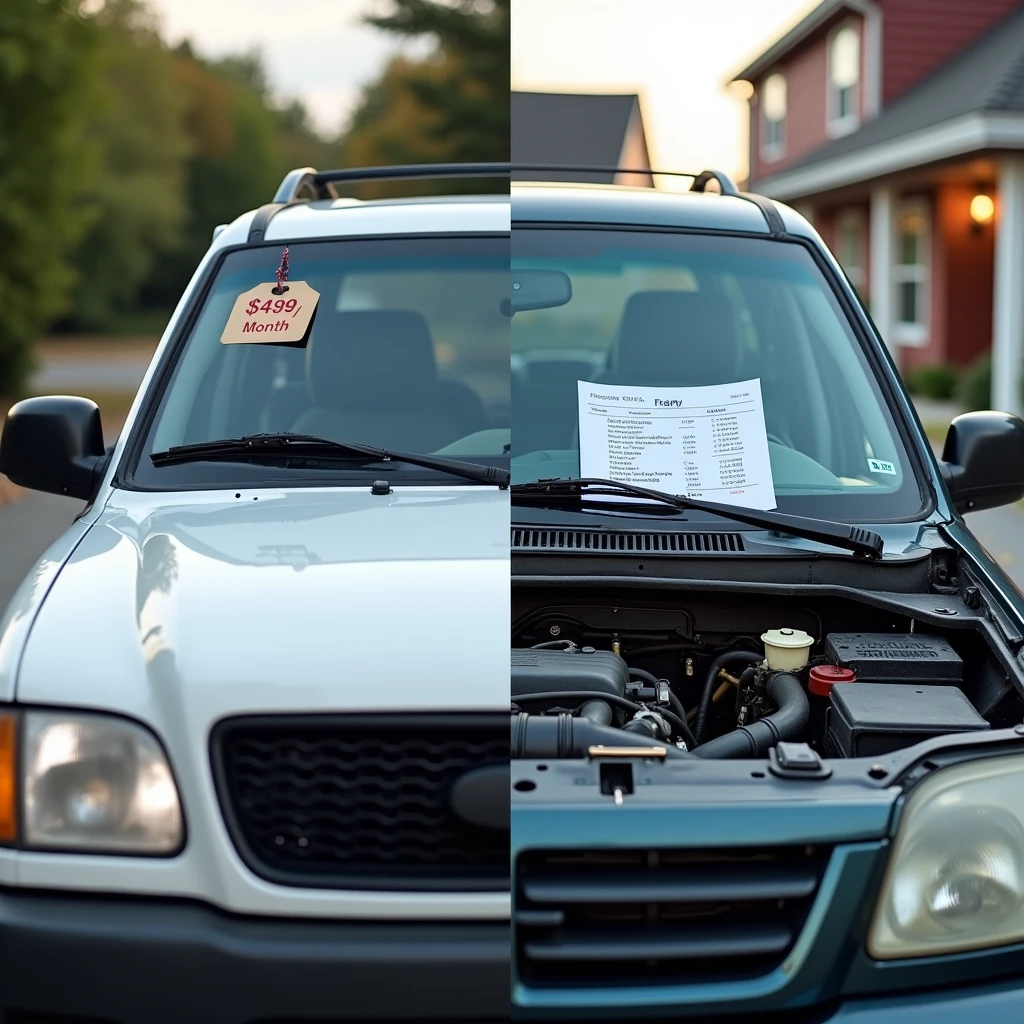
Long loan terms—72, 84, and now even 96 months—have become the norm. They're how automakers keep monthly payments manageable while vehicle prices climb. But they introduce risks that most buyers don't factor into the decision.
Negative equity becomes almost guaranteed.
Vehicles depreciate fastest in the first three years. On a 72-month loan, you're paying off the vehicle slower than it's losing value for roughly the first four years of the loan. If you need to sell, trade, or—worst case—the vehicle is totaled in an accident, you may owe more than the vehicle is worth. Standard auto insurance pays market value, not loan balance. The gap between what you owe and what the vehicle is worth comes out of your pocket unless you've purchased gap insurance, which itself adds cost.
Interest compounds longer.
A $35,000 vehicle financed at 6% over 60 months costs about $5,600 in total interest. The same vehicle at the same rate for 84 months costs about $7,900 in interest. That $2,300 difference buys nothing—no nicer seats, no better engine, no additional safety features. It's just the cost of stretching the payments out. At 72 months, the interest premium over 60 months is roughly $1,200 to $1,500 depending on the rate.
Warranty and repair timelines collide.
A 72-month loan means you're still making payments when the factory warranty expires at 36 or 60 months. That means you're paying for repairs on a vehicle you're still paying off—a particularly painful financial overlap. An 84-month loan extends that overlap further. The monthly payment plus the repair bill can strain a budget that looked fine when only the payment was considered.
If you plan to keep this SUV past the warranty window—which is what most family buyers should be planning—the loan term needs to end before major repair exposure begins, not overlap with it.
The Budget That Actually Works
A smarter approach starts with the total cost, not the monthly payment. Here's the framework I'd recommend to anyone shopping for a family SUV.
Know your total budget before you walk in.
This means the out-the-door price—vehicle, taxes, fees, everything—not the monthly number. A good rule of thumb: the total vehicle price should not exceed 35% to 40% of your annual household income, and ideally less. If your household earns $100,000, you’re looking at a $35,000 to $40,000 vehicle at most. That’s a well-equipped compact or midsize SUV with money left over for maintenance and fuel.
Finance for 60 months or fewer.
If the monthly payment on a 60-month loan is uncomfortable, the vehicle is too expensive. Period. Stretching the loan to make the payment fit is a signal that you're over-budget, not a solution to the over-budget problem. A 48-month loan is even better if your budget allows—less interest, faster payoff, equity builds sooner.
Put at least 10% to 20% down.
This reduces the amount financed, lowers interest costs, and provides a buffer against negative equity. If you're rolling negative equity from a trade into the new loan, you're starting the ownership experience underwater before you drive off the lot. In that case, consider keeping the current vehicle longer, paying down the negative equity before trading, or buying a significantly less expensive replacement.
Calculate the total cost of ownership, not just the payment.
The monthly loan payment is one line item. Fuel, insurance, maintenance, tires, and repairs are the others. A $500 monthly payment on a vehicle that gets 28 mpg and needs premium fuel costs more per month to operate than a $500 monthly payment on a vehicle that gets 28 mpg and needs premium fuel costs more per month to operate than a $550 payment on a hybrid that gets 40 mpg on regular. Run the full budget before you commit to either one.
On paper, this approach feels more restrictive than walking into a dealership and naming a monthly payment. In family use, it prevents the slow financial bleed that comes from paying more for longer for a vehicle that wasn't the right size for your budget in the first place.
What the Dealership Doesn't Want You to Know
The monthly payment framework is so effective at driving profits that the entire dealership sales process is built around it. Here's what's happening behind the conversation.
The four-square worksheet is a classic negotiation tool that presents monthly payment, trade-in value, down payment, and purchase price as four disconnected numbers. The salesperson moves between them, adjusting one to make another look better, while keeping the total transaction price—the one number that matters—obscured. It's designed to confuse, and it works.
Financing through the dealer often includes a rate markup. The dealership may be offered a buy rate from the lender—say, 5%—and present you with a contract at 7%. The difference is profit that goes directly to the dealership. This is legal and common. Getting pre-approved through a credit union or bank before visiting the dealership gives you a baseline rate and negotiating leverage. If the dealer can beat it, great. If not, you've already secured better terms.
Add-ons presented in the finance office are among the highest-margin products in the entire dealership. Extended warranties, maintenance plans, paint protection, fabric treatment, VIN etching—these are sold in the finance office after you've mentally committed to the vehicle, when resistance is lowest and the monthly payment framing makes them feel trivial. Some of these products have genuine value. Most are overpriced relative to what they deliver. All of them should be evaluated based on their total cost, not their monthly cost. Cancel them during the cancellation window if you regret the purchase after getting home and reviewing the numbers.
The honest truth: the dealership is not your financial advisor. It's a business that profits from the gap between what you pay and what the vehicle costs them. The monthly payment is the tool they use to widen that gap. If you walk in armed with total-cost thinking, pre-approved financing, and a firm out-the-door budget, you've neutralized their most effective sales tactic.
What I'd Tell My Brother
Here's the short version. Decide what you can afford based on the total purchase price, not the monthly payment. Get pre-approved at a credit union before you visit a dealer. Finance for 60 months or fewer—and if that monthly number feels too high, buy a less expensive vehicle. Put enough down to avoid being underwater from day one. Say no to every add-on in the finance office unless you've researched the cost independently and decided it's worth it.
The monthly payment is a distraction. The total cost is the truth. Keep your eyes on the truth, and you'll drive away in a vehicle that fits both your driveway and your budget. Let the monthly payment lead, and you'll probably drive away in something you'll resent two years from now when the repairs start and the payments still haven't stopped.
That's not a car problem. That's a math problem. And math problems have clear solutions if you're willing to do the arithmetic before the test drive, not after.



No letters yet — pray write the first.