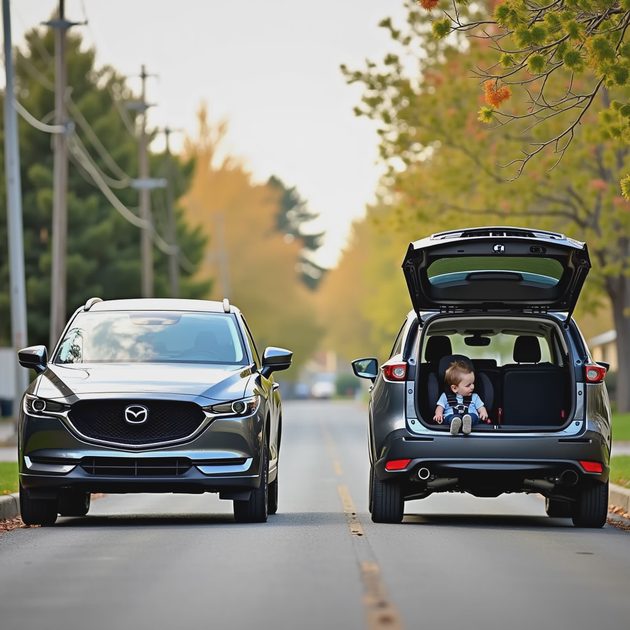
Let's keep this practical.
The Mazda CX-50 and Subaru Outback occupy the same corner of the family SUV market: slightly rugged, mildly adventurous, and sized right for parents who don't want something that feels like a school bus. Both come standard with all-wheel drive. Both offer a raised wagon silhouette instead of the traditional boxy SUV shape. And both attract buyers who want practicality without sacrificing the sense that they could take a dirt road detour if the mood struck.
But under the surface, these two make very different bets about what a family vehicle should prioritize. The Outback has been Subaru's bestseller for decades, refined over generations into something that prioritizes visibility, space efficiency, and all-weather confidence. The CX-50 is Mazda's newer, sharper take on the formula—trading some practicality for design and driving engagement. Here's how they compare where it counts for young families driving daily.
Space and Seating: The Practicality Gap Is Real
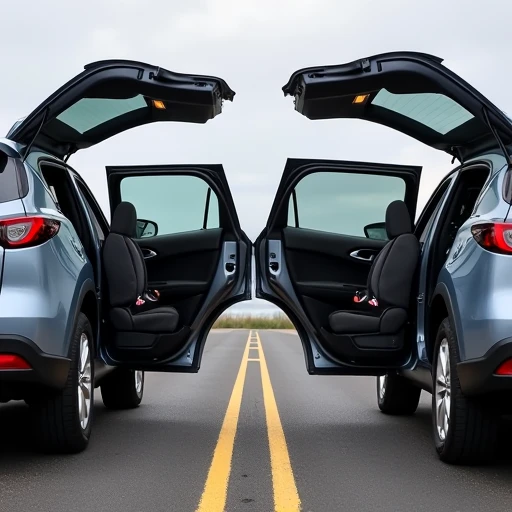
On paper, the cargo volume numbers look competitive. In daily family use, the Outback pulls ahead in ways that matter more than cubic feet.
The Outback offers 32.5 cubic feet of cargo space behind the second row, expanding to 75.6 cubic feet with the seats folded. The CX-50 counters with 31.4 cubic feet behind the rear seats and 56.3 cubic feet maximum. That's close enough on the smaller number to seem like a tie. But the Outback's cargo area is longer and wider, with a lower lift-over height that makes loading a stroller or a bulky cooler less of a shoulder workout. The Outback's squared-off rear roofline also means tall items slide straight in, while the CX-50's sleeker profile angles down sooner and limits what fits upright.
Rear-seat space tells a similar story. The CX-50 prioritizes front-seat occupants with a driver-focused cockpit that feels premium and snug. That design focus leaves rear passengers with less legroom and narrower door openings. Installing a rear-facing child seat in the CX-50 requires sliding the front passenger seat forward more than most parents expect. The Outback's boxier shape and taller greenhouse translate to wider-opening rear doors and more upright space for lifting a toddler into a car seat without ducking.
For families with young children still in rear-facing seats, this difference alone may decide the comparison. The spec sheet is only half the story—the other half is the daily ritual of loading kids in a tight parking space while holding a diaper bag and hoping the door doesn't swing into the car next to you.
Powertrain and Fuel Economy: Two Different Philosophies
Both vehicles offer a base engine and an upgraded turbocharged option, but the execution reveals different priorities.
The CX-50 starts with a naturally aspirated 2.5-liter four-cylinder making 187 horsepower, paired with a conventional six-speed automatic. It's adequate but will feel strained with a full load of passengers and cargo. The upgrade is a turbocharged 2.5-liter producing up to 256 horsepower on premium fuel—strong numbers that make the CX-50 genuinely quick for the segment. Fuel economy lands at 24 mpg city, 30 highway for the base engine, and 23/29 for the turbo.
The Outback counters with a naturally aspirated 2.5-liter flat-four making 182 horsepower and a turbocharged 2.4-liter flat-four at 260 horsepower, both paired with a continuously variable transmission. The base engine delivers 26 mpg city, 33 highway—slightly better than the CX-50. The turbo manages 23/30.
The real difference isn't the horsepower numbers. It's how the power is delivered. Mazda's six-speed automatic shifts with satisfying precision and feels more engaging. Subaru's CVT is tuned for smoothness and fuel efficiency, but it produces the characteristic drone under hard acceleration that some drivers find grating. For daily commuting and school runs, the Outback's setup is arguably more relaxed. For drivers who actually enjoy driving and want the vehicle to respond with some personality, the CX-50 delivers.
The turbo engines on both vehicles use premium fuel to achieve maximum output. Both will run on regular, but power drops slightly. If you plan to keep this SUV past the warranty window, pay attention here—both turbocharged options introduce the long-term maintenance considerations that come with forced induction. The base naturally aspirated engines in both vehicles are simpler, more predictable, and cheaper to maintain over an extended ownership window.
Daily Driving: On-Road Manners vs. Off-Road Credibility
Here's where the two vehicles' personalities diverge most clearly.
The CX-50 is the sharper on-road tool. Mazda tuned the steering for weight and feedback that make a winding road genuinely enjoyable. The suspension is firmer than the Outback's, which means better body control in corners but a stiffer ride over broken pavement and potholes. If your daily driving involves twisty back roads and you want the vehicle to feel connected and responsive, the CX-50 is the clear winner. The interior materials and design also feel more premium than the Outback's, with a more cohesive dashboard layout and higher-quality touch points.
The Outback prioritizes ride comfort and all-weather capability. The suspension absorbs rough pavement with less drama, and the 8.7 inches of ground clearance—slightly more than the CX-50's 8.5 inches—combines with Subaru's symmetrical all-wheel-drive system to deliver genuine confidence in snow, mud, and gravel. The Outback's all-wheel-drive system has been refined over decades and feels more capable when the pavement ends. The CX-50's all-wheel drive is competent but tuned more for on-road handling than off-road traction.
The visibility difference is significant and often overlooked in comparison reviews. The Outback's taller windows, thinner pillars, and larger rear glass area make it measurably easier to see out of in every direction. For parents navigating tight parking lots, school drop-off lines, and crowded suburban streets, that visibility translates directly to lower stress and better awareness of small children near the vehicle. The CX-50's sleeker styling comes with thicker rear pillars and a smaller rear window. Blind-spot monitoring is standard, but it's compensating for a design choice, not improving on a good baseline.
Long-Term Value: Resale, Reliability, and the Ownership Horizon
Both Mazda and Subaru have improved their reliability reputations significantly over the past decade, but the long-term ownership picture differs in ways that matter for family budgets.
The Subaru Outback holds its value exceptionally well. Subaru's loyal owner base and reputation for longevity support strong residual values across the lineup. The Outback consistently ranks among the top vehicles in its class for resale value retention, and Subaru's naturally aspirated engines have documented track records of reaching high mileage with routine maintenance. The CVT transmission had well-publicized issues in earlier generations, but reliability has improved measurably in recent model years, and Subaru extended CVT warranties on affected vehicles.
The Mazda CX-50 is newer to the market with less long-term reliability data available. Mazda's overall reliability ratings have climbed steadily, and the CX-50 shares its powertrain with the CX-5, which has posted strong reliability scores in recent years. Resale value for the CX-50 is projected to be solid but not quite at Outback levels—Mazda's brand perception still trails Subaru among practical-minded family buyers, which affects residual projections.
Both vehicles offer standard warranty coverage: 3 years/36,000 miles limited, 5 years/60,000 miles powertrain. Neither extends coverage as far as Hyundai or Kia, so long-term reliability and repair costs matter more for buyers planning to keep the vehicle past the warranty window.
Over five years of ownership with 12,000 miles driven annually, the Outback's fuel economy advantage with the base engine saves roughly $200-300 compared to the CX-50 base engine. The Outback's stronger resale value means more equity at trade-in time. Neither gap is enormous, but both tilt toward Subaru for the long-term spreadsheet.
Which One Makes More Sense for a Young Family?
Here's the honest breakdown based on real family priorities with young children.
Choose the Mazda CX-50 if:
Driving enjoyment ranks high on your priority list, and you want a vehicle that feels engaging on a daily commute
Interior design and premium materials matter more to you than maximum cargo practicality
Your children are out of rear-facing car seats, or you've confirmed the CX-50's rear-seat space works for your specific car seat setup
You prefer the feel of a conventional automatic transmission over a CVT
You live in a milder climate where the all-weather capability gap is less relevant
Choose the Subaru Outback if:
You have children in rear-facing car seats and need the easier rear-door access and more spacious back seat
All-weather capability and genuine snow performance matter for your daily driving
Visibility and outward sightlines are a safety priority, especially in school zones and tight parking situations
Maximum cargo flexibility for strollers, gear, and weekend trips ranks near the top of your list
Resale value and long-term ownership costs weigh heavily in your decision
My take for the typical young family of three or four: The Outback is the more practical all-arounder. It prioritizes the things that make daily family life easier—loading kids, seeing out, absorbing rough roads, and hauling gear—without asking for compromises on those fronts in exchange for style or driving engagement. The CX-50 is the more rewarding vehicle to drive and the nicer place to sit while parked. But for parents in the thick of car seats, strollers, and school drop-offs, the Outback's practical advantages show up every single day.
If the CX-50 speaks to you and the rear-facing seat test passes in your specific configuration, it's a strong choice that rewards the driver. Just make sure you're buying it because you genuinely prefer the driving experience—not because the styling makes the Outback look a little too much like a station wagon. On paper, the Outback's practical edge is real. In family use, it's even wider.

No letters yet — pray write the first.